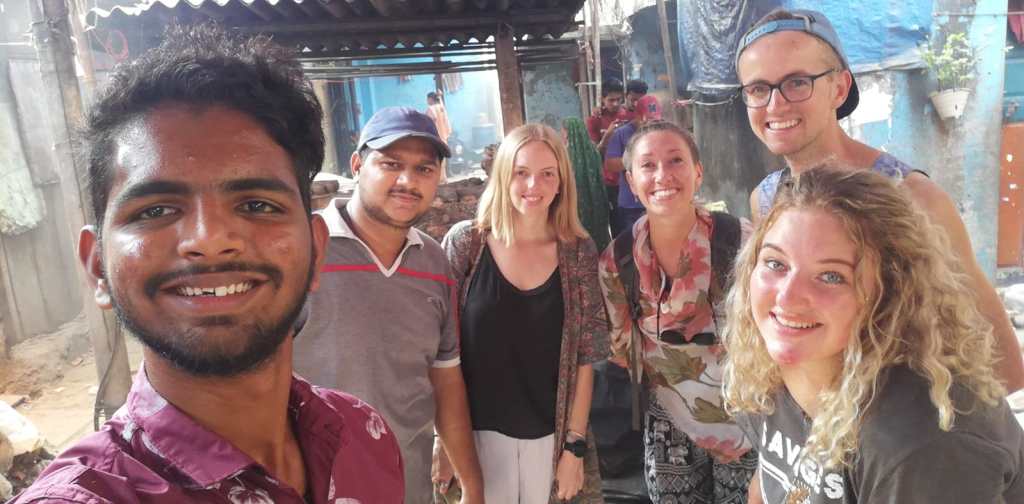
When Shannon asked if I wanted to go visit the 3rd largest slum in the world, I was really conflicted. We both weren’t sure how ethical it was. Do we pay to go on a tour of the 3rd largest slum in the world? While we were really interested to see the workings of the slum, we didn’t want to treat people like they were a spectacle.
After reading the Ungraceful Guides recommendations of a tour company we decided we wanted to go. The tour company was run by people who grew up in the slum. They give young people an opportunity to go and study and work part time as a tour guide. It all sounded great to me and the Ungraceful Guides are really ethical with their travels.
Shannon and I showed up at 9am in Churchgate station to meet our tour guide, Farzan and the trainee Mustafa. We were going to have the tour with 2 other travellers, a couple from Holland (always great craic). We got a train at Churchgate Station and got to the slum about 35 minutes later. We passed the largest open laundry in the world. India is just incredible. You see things on every corner that you’d never see in your wildest dreams in Ireland or England.
Our guide Farzan asked us if it was OK to ask us questions, which we all were. He first asked what our expectations were of this slum. I answered first with as honest an answer I could but was also conscious of being totally judgemental. I said my first thought when I heard the word slum, is disadvantage. I think people who are born into a slum are at a massive disadvantage in life and will struggle to exit that cycle of life, like anyone born into poverty. I had in my head that it would be over crowded, dirty, there would be a lack of facilities, there would be begging and it would be unsafe.
Our guide warned us to be wary but that it is safe, there are police and with them as guides we’d be completely fine.
He started the tour and 3 hours later…. Well… I felt completely different.
Dharavi, the third largest slum in the world is like no other place I’ve ever been before. There are over 1 million people living in Dharavi and this is in an area of 2.2 square kilometers. There are over 5000 industries within the slum; 1039 textile, 932 pottery, 567 leather, 722 recycling, 498 embroidery, 112 restaurants and several 1000 boutiques. There are over 1 billion US dollars generated by these industries every year. When Farzan reeled off this information, I was astounded. I couldn’t believe that this was all happening in 2.2 square kilometer of space in Mumbai. We visited a lot of different industries:
Recycling:
First we visited the recycling area. If my Eco club from school could see this now. We walked down a very small alleyway which was filled with bags of plastic. This area was where recyclable goods were delivered, crushed, washed, dried and sold. We looked at the plastics which were sold to melting companies. The melting of the plastics is done in more rural parts of India due to pollution. I wanted to ask if the melting of these plastics was done in a safe way and non harmful to the environment but I was afraid of the answer. From the plastics that are melted in India, there are over 6000 products. Mumbai has 40 metric tonnes of waste every day and 60% of this is recycled. As Farzan is giving us this information I’m absolutely amazed and have to remind myself that I’m in a slum in India. I ask myself, how is my old school not able to recycle aluminium cans properly? Seriously!
Textiles and suitcases:
Think of your suitcase that you take about 15 to 20 kg that you take on holiday for a week or so. Well, I witnessed it being made in a shed like office in a slum in Mumbai. From the material that covers the outside of the suitcase to the sewing and hammering, I witnessed it being made. This shop makes about 150 suitcases per day. There are 2 machines in the shop, a sewing machine and a drill machine. After this the stitching and hammering is done by hand. The luggage is sold for between 700 and 1200 rupees each. This is equivalent to £7.50 to £13 so the shop does pretty well in a day!
Community kitchens:
Here, the workers of the slum can get all of their meals provided. It costs 550 rupees per week. This provides 3 meals per day, 6 days a week and 2 meals on the 7th day. They also provide a delivery service. Again, I have to compare the opinion I had at the beginning of the tour to what I was seeing now. I’m in a slum and all of this is happening every day. As we walked through the industrial area we weren’t allowed to take pictures. I was amazed how there is no waste. Although india has a huge amount of waste, in the slum everything is used or reused or recycled.
Leather shops:
There are leather shops here as well. I’ve never liked the smell of leather and the concept of it kills me, I tried walking in and as the guides spoke about the process, I had to leave. It made me feel physically ill. Although this wasn’t my favourite spot of the tour I still had to admire how this industry is so successful. There was a shop next door to the leather maker selling goods that were made in the slum. To see a product actually from start to finish (bar the skinning of the cow) was absolutely fascinating. I am so used to seeing the finished product appear on my shelves in England and Ireland that I’ve no real concept of what it looks like as it’s being produced.
Bakeries:
There are 200 bakeries in Dharavi. We got to peek inside a working bakery and taste the products. The puff pastry that we tasted are normally eaten at breakfast with a cup of chai. They are rectangular in shape and I’ve seen them being sold in plastic bags around India. We got to taste them before they went into the plastic bag. They were delicious. For 20 rupees (22p), you can get 8 of them in a bag which will feed a family for breakfast alongside the chai.
Hand embroidery:
As we wandered through the tiny alleyways around the residential area, we passed families going about their daily lives, men working, women washing, kids came to the door to say hello to us and wave. The residential area was like any other community we’ve seen as we travel. They are overcrowded and we saw quite a few rats along the way. Surprisingly there are actually lots of cats in Mumbai and Dharavi is no different. There were loads of ctas sprawled out in the residential area.
As we wandered further in we passed more workshops, of which were filled with up to 8 men on sewing machines. Working conditions were pretty poor, cramped and very hot. If there was a fire in these workshops I’d hate to think of the damage that would happen. When we asked our guide about this he showed us the blue tank of water that is available to put out a fire. I’m doubtful of the effectiveness of this method. We finally met a man who was doing hand embroidery in a workshop with one other man. I’d had a go at hand embroidery back in the day of primary school. It must have taken an age for us to complete a 2cm^2 piece of cloth. We watched as this man tore through the fabric making identical flowers using thread which he will add sequences and gems to after. He seemed like a really lovely man.
Schools:
There are 78 schools within Dharavi including kindergarten, primary school, secondary school and upper secondary school. Students who desire to go to university must exit the slum. The guide told us that when he started in university, he met a girl. After some time she asked where he was from. Once he said it was Dharavi, she walked away and told him to never speak to her again. These students would have to work for a while to be able to attend university. Farzan didn’t have the numbers for me but not many have an opportunity to attend university and when the do they are met with people who judge them for where they are from. Because of the amount of students needing to attend school all over india, there are 2 shifts. The morning shift attend from 7 to 12 and then than the afternoon shift are from 1 to 6. This can vary depending on the school.
In Dharavi there is 90% to 95% school attendance. The minimum age for working is 14 which would make me assume a lot of kids drop out of school at this age to get to work. ALthough most indian families want their kids to do more and have more than them, there sometimes isn’t an option other than to send the kids to work. There are working conditions for these young workers. They are entitled to an hour break in a shift or 8 to 9 hours. When I met a girl in Pushkar who left her family at the age of 14 to work, I couldn’t understand it. This is very common in India. To me a 14 year old is meant to be in school, the only responsibility to attend school.
Pottery:
In India, you can get your chai from a small clay pot. When I first got this, I was appalled that my friends told me to chuck it in the bin when I was done with it. I felt terrible but was reassured that these are disposable. Seeing the pottery makers at work was fascinating. The gentleman we saw working the small pots made a small clay pot in less than 10 seconds. They shape the clay, let it dry, bake it and then the women design them. It was beautiful to see.
At the end of the tour I was feeling overwhelmed about the whole experience. I thought it was absolutely amazing and the guides did an incredible job. They provided a first hand insight into the workings of Dharavi. I was still struck by the poverty of the people living there. The working conditions were poor and payment was pittance but this is in comparison to my world that I’ve grown up in. Kids go to school, the have gorgeous clean uniforms, women are feeding their families and keeping a strong community thriving, there’s businesses thriving and generating more money than I could have ever imagined.
My previous understanding of a slum had been smashed to pieces and I was left with a completely different view of these chaotic, crazy, over crowded 2.2 square kiometer space filled with over 1 million people.
 30 Is Squares Big Adventure Year